
The pharmaceutical industry demonstrated resilience and innovation in Q3 2024, with standout performances from major players driving significant growth and reinforcing the sector’s robust trajectory. From breakthrough therapies to strategic market maneuvers, here’s how the Top 15 Pharma Companies navigated the quarter’s challenges and opportunities.
Key Performance Highlights:
Pfizer
Pfizer capitalized on strong COVID-19 product sales but faced hurdles in its non-COVID portfolio, notably with Xeljanz. This duality underscores the company’s need to diversify revenue streams and reduce dependency on pandemic-related products.
Johnson & Johnson (J&J)
J&J delivered 5.2% growth, fueled by a thriving U.S. market. With its broad portfolio and consumer trust, J&J remains a cornerstone of stability and growth in the sector.
Roche
Roche showcased resilience, balancing strong growth in pharmaceuticals and diagnostics against currency headwinds and biosimilar competition. Its strategic focus on innovation continues to pay dividends.
Merck
KEYTRUDA stood out as a growth engine for Merck, compensating for a slight dip in Gardasil sales. Merck’s oncology dominance underscores its ability to adapt to shifting market demands.
AbbVie
Immunology powerhouses Skyrizi and Rinvoq led the charge for AbbVie, effectively offsetting challenges in aesthetics and Humira’s declining market share. This shift highlights AbbVie’s successful pivot in its growth strategy.
Novartis
Despite currency and R&D cost pressures, Novartis posted strong growth driven by innovative launches. Its commitment to pipeline advancements signals long-term confidence.
Bristol-Myers Squibb (BMS)
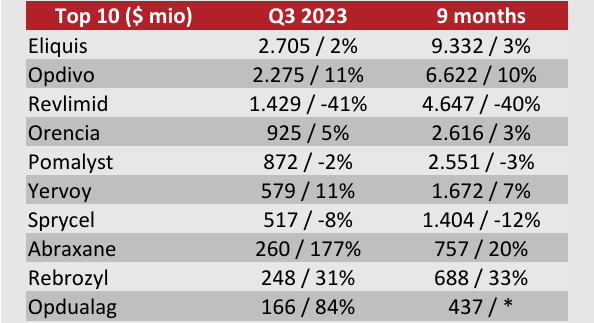
Revlimid and Eliquis provided a much-needed boost, enabling BMS to raise guidance amidst ongoing patent cliffs. The company’s strategic adjustments show its agility in a competitive landscape.
Sanofi
Sanofi’s vaccine division outperformed, bolstering overall growth. However, supply constraints for GLP-1 therapies, including Ozempic, highlighted vulnerabilities in the supply chain.
AstraZeneca
A remarkable 21% revenue surge cemented AstraZeneca’s leadership in oncology and rare diseases. Emerging market margin pressures are a watchpoint as the company expands globally.
GlaxoSmithKline (GSK)
GSK exceeded EPS expectations, but Shingrix sales encountered obstacles. Despite this, its diversified portfolio continues to drive steady performance.
Takeda
With Entyvio leading the charge, Takeda raised guidance, even as the IBD space becomes increasingly competitive. This reflects the company’s focused execution and innovation.
Eli Lilly
While Q3 was impacted by GLP-1 supply issues, Eli Lilly’s long-term growth story remains intact, with promising pipeline projects expected to drive future momentum.
Gilead
Higher guidance for FY24 stemmed from robust HIV sales, though oncology remains an area of underperformance. Gilead’s strategic pivot in this area will be crucial going forward.
Amgen
Anticipation builds for Amgen’s Phase 2 MariTide data, with potential to redefine obesity treatment. This could mark a turning point for the company’s growth trajectory.
Novo Nordisk
Novo Nordisk shattered expectations with Wegovy sales, although Ozempic and Rybelsus faced supply limitations. The company’s dominance in the GLP-1 space signals ongoing growth potential.
Q3 Reports Summary
- Analysts have appraised the third-quarter results as robust and promising for the majority of pharmaceutical companies.
- They have highlighted the ongoing commitment to research and development (R&D) investments, strategic mergers and acquisitions (M&A) activities, divestments and advancements in pipelines.
- However, lingering concerns persist regarding pricing pressures, regulatory challenges, and the potential impact of patent expirations on future earnings.
- Some companies are in the process of planning or executing restructuring plans to improve efficiency (e.g. Novartis, Bayer), and non-core business spin-offs were completed or in process (Sandoz, Consumer business in J&J).
- Oncology continues to be the most attractive market for leading companies, while the obesity market is garnering increased attention with Novo Nordisk and Lilly experiencing rapid success and new promising developments on the horizon (e.g. Pfizer, Amgen, AstraZeneca).
- Although prominence of COVID-19 in portfolios is diminishing, interest in vaccines remains high, with the respiratory syncytial virus (RSV) market becoming highly competitive and witnessing new developments across other areas.
- Some companies face potential risks due to over-reliance on one or two products and should consider diversifying their portfolios in the future.
- Merger and acquisition activities remain noteworthy, with certain companies actively engaged in this realm. It is anticipated that new deals will materialize in the coming months.
- In summary, the overall outlook for the pharmaceutical industry remains positive, with expectations for sustained growth and continued innovation.
Summary of Key Figures
Jan-Sep: Pharma + Vaccines Sales ranking in USD

Pfizer
Company's view
Dr. Albert Bourla, Chairman and CEO, said Pfizer was encouraged by the strong performance of its non-COVID products in Q3 2023, citing significant contributions from new launches and robust year-over-year growth for several key in-line brands. He highlighted recent milestones including U.S. and EC approval of Abrysvo, U.S. approval of Elrexfio, U.S. approvals of Penbraya, Velsipity and the Braftovi+Mektovi combination in BRAF-mutated NSCLC, and EC approval of Litfulo. He also noted continued progress toward the proposed Seagen acquisition, having received unconditional antitrust clearance from the EC.
Outlook: Reaffirms Full-Year 2023 Non-COVID Operational Revenue Growth Expectation of 6% to 8% vs. 2022.
Product Sales — Top 10 ($ mio)
Clinical Development / Regulatory
- Abrilada (adalimumab-afzb) – In October 2023, the FDA designated Abrilada as an interchangeable biosimilar to Humira (adalimumab).
- Abrysvo – In August 2023, the FDA approved Abrysvo, Pfizer's bivalent RSV prefusion F (RSVpreF) vaccine.
- Braftovi (encorafenib) and Mektovi (binimetinib) – In October 2023, the FDA approved the combination for adult patients with metastatic NSCLC with a BRAF V600E mutation.
- Litfulo (ritlecitinib) – In September 2023, the EC granted marketing authorization for this once-daily oral capsule to treat adults and adolescents 12+ with severe alopecia areata.
Analyst's view
Morgan Stanley: Noted a slight miss on Q3 revenue but reiterated updated 2023 guidance; viewed mRNA seasonal flu Phase 3 data as mixed while awaiting danuglipron Phase 2 obesity data.
Barclays: Highlighted a solid Q3 print across the core business, with the Abrysvo RSV launch far exceeding estimates. Noted forthcoming danuglipron Phase 2 data as the next major overhang, with shares likely range-bound until there is clarity.
Goldman Sachs: Observed expected COVID-19 franchise weakness, a firmer base business, and continued anticipation of danuglipron results.
Johnson & Johnson
Company’s view
Analyst’s view“Johnson & Johnson delivered strong results and significantpipeline advances in the third quarter, providing a solidfoundation for future sustained growth,” said Joaquin Duato, Chairman of the Board and Chief Executive Officer. “With a sharpened focus on Innovative Medicine and MedTechsolutions, Johnson & Johnson is innovating across the spectrum of healthcare and is poised to deliver the medical breakthroughs of tomorrow.”
The financial results and earnings guidance reflect the continuing operations of Johnson & Johnson. The Company recognized a one-time, non-cash gain of approximately $21 billion in the quarter as part of discontinued operations relatedto the final separation of its Consumer Health business.
Meanwhile, chief financial officer Joseph Wolk indicated that European sales of Stelara could decline from the middle of next year after a key patent expires. "We could see a little bit of an impact,” Wolk said.
Outlook: Raised
Company is increasing 2023 full-year guidance midpoints for sales and adjusted EPS
Product sales / Clinical / Regulatory
Clinical Development / Regulatory
• U.S. FDA and EC Approves TALVEY (talquetamab-tgvs), a First-in-Class Bispecific Therapy for the Treatment of Patients with Heavily Pretreated Multiple Myeloma
• U.S. FDA Approves AKEEGA (Niraparib and AbirateroneAcetate), the First-And-Only Dual Action Tablet for the Treatment of Patients with BRCA-Positive MetastaticCastration-Resistant Prostate Cancer
• Janssen to Highlight Latest Research from NipocalimabClinical Development Program to Address Unmet Need in Myasthenia Gravis at AANEM 2023 Meeting
• TREMFYA (guselkumab) Maintains Key Efficacy EndpointsThrough Three Years for Adults with Moderately to Severely Active Crohn's Disease in a Phase 2 Study
Analyst’s view
BernsteinRevenue and EPS beat consensus by 1.5% and 5.5%, respectively. Guidance came up: JNJ now expects 2023 adjoperational sales growth in the range of 7.2% to 7.7% (vs. prior 6.2% to 7.2%). Adj EPS guidance came up by 10 cents at the midpoint to $10.02 to $10.08 (vs. prior $9.90 to $10.00).
Unfazed by GLP-1s. Bariatric procedure volumes saw a mid-single-digit year-over-year decline in Q3 given the risingpopularity ofGLP-1s. But JNJ noted that bariatric surgeonssee surgery and weight loss drugs as being complimentarytreatments over the longer term. In fact, GLP1s could be a tailwind to bariatric surgery over time given rising awarenessof obesity and more patients willing to seek treatment.
Continued strength in medtech markets. JNJ believes the strong medtech market growth we're seeing in 2023 (5%-7% in markets where JNJ participates, vs. 4%-6% in normal years) will continue in 2024. Despite questions about GLP-1s and China, the company sees continued robust growth in medtech, and they "don't anticipate that trend changing in the foreseeable future".
M&A appetite still "voracious." CFO Joe Wolk clarified what he meant when he said JNJ had a "voracious" appetite for M&A on the 2Q23 call. While some came away thinking JNJ wantedto do a big acquisition, Wolk clarified that while managementare eager to do deals, they could be large or small, and they could be in MedTech or in Pharma.
Talc update. VP of Litigation Erik Haas offered a thoroughupdate on the company's 4- pronged approach to addressingtalc liability
Roche

Company’s view
Roche CEO Thomas Schinecker:
“We achieved good results in the first nine months of 2023, more than compensating for the expected decline in demand for COVID-19 products. Our Group sales excluding COVID-19 products continued to grow strongly by +9% at constant exchange rates. Additionally, we made significant progress in our product pipeline with numerous positive clinical studies. I am particularly pleased about the phase III data for Alecensa in early-stage lung cancer. Treating cancer at an early stage may give patients a chance for a cure. We confirm our outlook for 2023.”
Outlook: Confirmed
Due to the sharp decline in sales of COVID-19 products of roughly CHF 4.5 billion, Roche expects a decrease in Group sales in the low single digit range (at constant exchange rates). Excluding this COVID-19 sales decline, Roche anticipates strong sales growth in both divisions’ base business.
Core earnings per share are targeted to develop broadly in line with the sales decline (at constant exchange rates). Roche expects to further increase its dividend in Swiss francs.
Product sales / Clinical / Regulatory

Clinical Development / Regulatory
- EU approval of Evrysdi for babies under two months old with spinal muscular atrophy
- First approval of subcutaneous form of Tecentriq
- Positive phase III data for Alecensa (early-stage lung cancer) and Ocrevus (subcutaneous injection; MS)
- Positive phase II data for zilebesiran (hypertension in patients at high risk of cardiovascular disease) and additional positive phase II data for fenebrutinib (MS)
- Positive longer-term efficacy and safety data for Ocrevus (MS) and Vabysmo (retinal vein occlusion)
- Launch of first validated test for earlier diagnosis of neonatal sepsis and new module to improve laboratory efficiency
Analyst’s view
Morgan Stanley:
The unchanged FY23 guidance (despite CHF845m less COVID/biosimilar drag) implying FX driven consensus cuts for FY23. Group sales were in-line with consensus with Pharma beating by CHF70m / 1% and Diagnostics missing by CHF114m / 3%. The standout positives were Vabysmo once again beating expectations by 10% (+CHF61m; 37% new patient starts are naïve in the US, up from 30% 2Q23; 19% share in nAMD vs 15% 2Q23 and 12% share in DME vs 9% 2Q23) with strong performance across geographies. Roche has commented that it has seen no impact of Eylea HD yet with the J-code not expected until Apr-24. Polivy beat consensus by 13% reflecting stronger than expected broad 1L DLBCL uptake, with the company increasingly confident in $2bn+ potential for the indication. Actemra significantly surprised to the upside with performance (+20%) drive by stable trends in the immunology.
JP Morgan:
Overall, despite the in-line quarter, we believe the market may be somewhat disappointed by the lack of a guidance raise and some of the key products missing expectations. However, even though the guidance implies a 4-5% trim to Consensus Core EPS estimates, we could envisage the number only coming down by the FX cut of 2%.
Merck

Company’s view
“Our strong results this quarter reflect our talented team’s commitment to bringing forward important innovation and pursuing breakthroughs for all those who count on us,” said Robert M. Davis, chairman and chief executive officer, Merck. “We continue to push the boundaries of science, making disciplined investments to augment our diverse pipeline and applying our expertise to accelerate potentially transformative treatments to address patient needs – including through our recently announced collaboration with Daiichi Sankyo. I am proud of our progress as we continue to execute at the highest level and work to generate strong and sustainable value, today and well into the future.”
Outlook: Raised
Merck continues to experience strong sustained demand for key growth products, particularly in oncology and vaccines. As a result, Merck is raising and narrowing its full-year sales outlook. Merck now expects full-year sales to be between $59.7 billion and $60.2 billion, including a negative impact of foreign exchange of approximately 2 percentage points, at mid-October 2023 exchange rates. This full-year outlook includes approximately $1.3 billion of LAGEVRIO sales.
Product sales / Clinical / Regulatory

Clinical Development / Regulatory
- FDA Approved KEYTRUDA for Treatment of Patients With Resectable (T≥4 cm or N+) NSCLC in Combination With Chemotherapy as Neoadjuvant Treatment, Then Continued as Single Agent as Adjuvant Treatment After Surgery, Based on Results From Phase 3 KEYNOTE-671 Trial
- KEYTRUDA Plus Padcev Reduced Risk of Death by More Than Half Versus Chemotherapy in Patients With Previously Untreated Locally Advanced or Metastatic Urothelial Cancer, Based on Results From Phase 3 KEYNOTE-A39/EV-302 Trial
- FDA Accepted for Priority Review a New BLA for Sotatercept, an Activin Signaling Inhibitor to Treat Adults With PAH, Based on Results From Phase 3 STELLAR Trial; FDA Set PDUFA Date of March 26, 2024
Analyst’s view
JP Morgan:
More broadly on MRK, we continue to view the company as having one of the cleanest paths to upside in both near-term and longer-term numbers in the group (led by Gardasil, Keytruda, and a growing late-stage pipeline), and we estimate double-digit EPS growth through the late 2020s (prior to Keytruda’s LOE).
Wells Fargo:
MRK 3Q: Beat Driven by Lagevrio Could Limit Upside; Raise Seems More Fundamental Though. Lagevrio seemed to drive much of the 7% topline beat of $16B vs. consensus $15.3B. Topline guidance was raised by 1.4% at mid point but Lagevrio contributed ~0.4% to this raise. Overall a beat & raise quarter but COVID-driven beat could limit upside.
Barclays:
Keytruda posted a meaningful beat above Cons driven by ex-US (+$110mn) with US slightly above consensus (+$8mn). Gardasil was in-line with an ex-US beat (+54mn) evening out a US miss (-$54mn). Gardasil growth was attributed strong demand in China and higher pricing in the US partially offset the timing of CDC purchases. Keytruda growth was attributed to increased uptake in earlier-stage cancers citing TNBC and RCC while its metastatic indications also saw strong demand.
AbbVie

Company’s view
"We delivered another quarter of outstanding results driven by accelerating performance across our non-Humira growth platform, which is demonstrating double-digit growth," said Richard A. Gonzalez, chairman and chief executive officer, AbbVie. "Based upon the strength and momentum of our business, we are once again raising our full-year 2023 guidance as well as our floor EPS outlook for next year. We are also increasing our quarterly dividend, underscoring our confidence in AbbVie's long-term outlook."
Outlook: Raised
AbbVie is raising its adjusted diluted EPS guidance for the full year 2023 from $10.86 - $11.06 to $11.19 - $11.23, which includes an unfavorable impact of $0.27 per share related to acquired IPR&D and milestones expense incurred year-to-date through the third quarter 2023. The company's 2023 adjusted diluted EPS guidance excludes any impact from acquired IPR&D and milestones that may be incurred beyond the third quarter of 2023, as both cannot be reliably forecasted.
Product sales / Clinical / Regulatory

Clinical Development / Regulatory
- Positive topline results from SEQUENCE, a Phase 3 study evaluating Skyrizi versus Stelara (ustekinumab) in patients with moderately to severely active Crohn's disease (CD) who have failed one or more anti-TNF therapies.
- European Commission (EC) granted conditional marketing authorization for Tepkinly (epcoritamab) as a monotherapy for the treatment of adult patients with relapsed or refractory (r/r) diffuse large B-cell lymphoma (DLBCL) after two or more lines of systemic therapy
- AbbVie announced that the (EC) approved Aquipta (atogepant) for the prophylaxis of migraine in adults who have four or more migraine days per month.
Analyst’s view
Morgan Stanley:
Skyrizi and Rinvoq were both ahead of cons. this quarter. We were particularly encouraged by the commentary on uptake in IBD and note that positive data from Ph3 Skyrizi vs. Stelara (HERE) will continue to drive uptake in CD and should help stave off pressure from biosimilars. Mgmt reiterated that they have not seen a fundamental change in market pricing dynamics and do not expect HSD pricing pressure for either product in 2024, as only one large new indication (Skyrizi in UC) is expected next year vs. 7 new indications in 2023.
GLP-1/aesthetics dynamics: ABBV commented that anything that gets a subset of patients engaged in their appearance, including weight loss products like GLP-1s, would likely have a positive tailwind for the aesthetics franchise. Mgmt pointed out that many of their customers are bringing GLP-1's into their practice and see it as a natural opportunity to cross-sell. However, caveating that in the short term it could put a pressure on higher-price products (e.g., fillers or body contouring), which has not been observed at this point given potential masking from broader macroeconomic dynamics.
Wolfe Research:
ABBV remains confident in S+R pricing in 2024 - and realistically, it has probably had enough payer discussions already to know this. The company said analysts modeling US Humira >$8B is too aggressive (we were published at $9.1B, but our confidence in this figure has gradually eroded since summer, given how fast biosimilar pricing has dropped; our revised number is lower now).
Novartis

Company’s view
Commenting on the quarter, Vas Narasimhan MD, CEO of Novartis, said:
“Novartis delivered a very strong quarter, with double-digit sales and core operating income growth leading to a further upgrade to 2023 guidance. We have successfully executed the spin-off of Sandoz, allowing us to fully focus on high-value innovative medicines. Our growth drivers, including Kesimpta, Entresto, Kisqali and Pluvicto, continue to perform well in the market. Our robust pipeline also continues to deliver, and we have achieved important innovation milestones for Pluvicto, iptacopan, remibrutinib and Lutathera. We are confident in our mid-term growth outlook and remain committed to creating value for our shareholders.”
Novartis has completed its transformation into a “pure-play” innovative medicines business, with the successful spin-off of Sandoz. Our focus is now centered on four core therapeutic areas (cardiovascular, renal and metabolic; immunology; neuroscience, and oncology).
Outlook: Raised
Full-year 2023 guidance raised based on strong momentum
- Net sales expected to grow high single digit
- Core operating income expected to grow mid to high teens (from low double digit to mid teens)
Product sales / Clinical / Regulatory

Clinical Development / Regulatory
- Leqvio - Approved in China and Japan as the first and only small interfering RNA (siRNA) therapy for LDL-C reduction
- Cosentyx - In October, FDA approved the intravenous formulation in three indications: Psoriatic Arthritis, Ankylosing Spondylitis, and non-radiographic axial SpA
- Kisqali - EU file submission in adjuvant early breast cancer setting; US submission planned for Q4 2023
- Adakveo - EC adopts decision endorsing CHMP recommendation to revoke conditional marketing authorization
Analyst’s view
Morgan Stanley:
A strong operating performance reflected in an anticipated FY23 guidance raise that sets the company up for another potential guidance beat at the FY23 results and above consensus EPS momentum for 2024. We expect investors to focus on the Kisqali NATALEE overall survival data update and Pluvicto positioning following the PSMAfore presentation heading into the R&D Day 28 November.
Jefferies:
Analyst Peter Welford noted that while sales exceeded expectations, a large portion of the beat was due to a one-time boost in revenue for multiple sclerosis drug Kesimpta in the EU.
Bristol-Myers Squibb

Company’s view
“My excitement for the company's future is centered on the diversification of our business, the breadth of our new product portfolio and the strength of our pipeline,” said Giovanni Caforio, M.D., board chair and chief executive officer, Bristol Myers Squibb. “I am proud of what we have achieved together and look forward to what the dedicated people of our company will continue to accomplish for patients.”
Chief financial officer David Elkins noted that new products, including Reblozyl, Sotyktu and Zeposia, are on target to hit around $3.5 billion in sales this year. However, Bristol Myers Squibb now expects its new product portfolio to generate over $10 billion in revenue in 2026, pushed back from an earlier forecast of between $10 billion and $13 billion in 2025. "The long-term potential of these brands remains the same," Elkins said.
Outlook: Maintained
Bristol Myers Squibb is revising its 2023 GAAP and Non-GAAP line item guidance as follows:
Adjusting total revenues for Revlimid to be approximately $6.0 billion.
Adjusting GAAP diluted EPS range to $3.68-$3.83 and raising midpoint of Non-GAAP diluted EPS range, with the new range being $7.50-$7.65. Adjusting GAAP tax rate to approximately 11% and adjusting Non-GAAP tax rate to approximately 15.5%, primarily due to a reduction in previously estimated taxes resulting from changes in the income tax guidance regarding deductibility of certain non-U.S. research and development expenses.
Product sales / Clinical / Regulatory
Clinical Development / Regulatory
- Bristol Myers Squibb recently achieved significant regulatory and clinical milestones, including an important U.S. regulatory approval for Reblozyl in first-line, MDS-associated anemia.
- In addition, the company achieved strong results from a Phase 3 study evaluating subcutaneous nivolumab and received two key approvals—from the U.S. Food and Drug Administration (FDA) and the European Commission for Opdivo in stage IIB or IIC melanoma.
- The company also announced initial data from a Phase 3 trial evaluating a perioperative regimen including Opdivo in non-small cell lung cancer, as well as positive Phase 2 results evaluating its potential first-in-class LPA1 antagonist in progressive pulmonary fibrosis.
Analyst’s view
JP Morgan:
Overall, 3Q was a disappointing update for BMY with the company lowering both near- and medium-term targets for the new product portfolio (somewhat expected) as well as its medium-term target for OpMs (less expected) and we are lowering numbers as a result. While admittedly we see few near-term catalysts to improve sentiment, much of today's update appears priced into shares with the Street broadly expecting a cut to new product launch forecasts and shares trading at ~7.5x our revised 2024 EPS.
Barclays:
We've argued for much of '23 that BMY shares would struggle to gain ground until the company could meet, much less beat its New Product Portfolio (NPP) expectations - which looked overly optimistic given a mixed set of performances over the past 2 years. Bristol lowering the NT outlook wasn't particularly surprising, and felt more overdue than particularly revelatory.
BofA Global Research:
Overall, we continue to have an optimistic view on the “Big 9” new launches and see inflection as a matter of “when and not if.” Indeed, we expect the newly expanded product portfolio with repotrectinib and Krazati next year to further enhance Bristol's growth profile long term. Although we remain positive on the Bristol story overall, we're lowering PO on the delayed revenue inflection.
Sanofi

Company’s view
Paul Hudson, Sanofi Chief Executive Officer, commented:
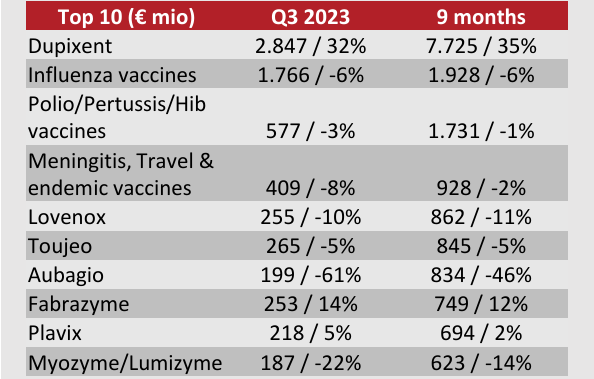
“The continued impressive performance of Dupixent®, the highly anticipated launch of Beyfortus® for the protection of all infants against RSV and the strong uptake of ALTUVIIIO® in hemophilia were key drivers in the quarter, exemplifying our successful strategy execution towards sustainable growth from innovative medicines. The underlying strength of our growth drivers more than offset the expected impact from generic competition on Aubagio® in U.S. and lower sales from mature products across the General Medicines portfolio in the quarter. With our two recent business development deals in immunology and vaccines, we are further strengthening the core of our innovative pipeline and follow our strategic focus of transforming the practice of medicine through breakthrough science. As we enter a compelling next chapter of our company's Play to Win strategy, we remain confident in the outlook for the last quarter and consequently keep our full-year earnings guidance unchanged.”
Outlook: Confirmed
Full-year 2023 business EPS guidance reiterated
- Sanofi expects 2023 business EPS to grow mid single-digit at CER, barring unforeseen major adverse events.
- Applying average October 2023 exchange rates, the currency impact on 2023 business EPS is estimated between -6.0% to -7.0%.
- This guidance includes approximately €400 million of expected one-off COVID vaccine revenues in the fourth quarter.
Product sales / Clinical / Regulatory
Clinical Development / Regulatory
- Beyfortus® U.S. approval for prevention of RSV lower respiratory tract disease in infants
- ALTUVIIIO® approval for hemophilia A in Japan and Nexviazyme® for the treatment of Pompe disease in China
- Fitusiran, a first-in-class, investigational subcutaneously administered siRNA therapy, is currently in phase 3 clinical development for the treatment of haemophilia A or B, with or without inhibitors
- Sanofi decided to discontinue the development of eclitasertib (RIPK1 inhibitor) in cutaneous lupus erythematosus (CLE), based on the efficacy results of the Phase 2 proof-of-concept study.
Analyst’s view
Jefferies:
3Q sales 1% miss as BioPharma in-line, with focus Dupixent ahead, but Consumer 3% miss. Weaker gross margin partly offset by lower OpEx for 2% miss at EBIT and EPS. 2023 outlook reiterated (not raised). Decision to list Consumer 4Q24+ has been eagerly awaited, but R&D is prioritised over 32% 2025 margin aim, which is strategically sensible, in our view, but likely sees potential -6%-8% cons profit cuts 2024, moderating a bit in future years. Shares likely off.
UBS:
Company reported sales of €2,874m for Dupixent 3.5% above consensus, €10,719m for BioPharma broadly in-line with consensus, €1,245m for Consumer Healthcare 2.7% below consensus. Cost of goods sold of -€3,840 was 2.2% above consensus and Gross Profit of €8,858 was 2.9% below consensus. Sanofi has announced its intention to separate the Consumer Healthcare Business, by creating a listed entity headquartered in France. Pipeline updates include that Sanofi is currently in discussions with the FDA regarding filing of fitusiran in 2024, and whilst a Phase II study of rilzabrutinib in chronic spontaneous urticaria (CSU) met its primary endpoint, a Phase II study evaluating rilzabrutinib for atopic dermatitis did not.
AstraZeneca

Company’s view
Pascal Soriot, Chief Executive Officer, AstraZeneca, said:
“Our company continued its strong growth trajectory in the third quarter with Total Revenue from our non-COVID-19 medicines up 13% compared to last year.
We initiated several Phase III trials of high-potential molecules this quarter, including for volrustomig, our PD-1/CTLA-410 bispecific antibody. Our portfolio of bispecifics has the potential to replace the first-generation checkpoint inhibitors across a range of cancers. We also initiated a fixed dose combination study of zibotentan with Farxiga which has the potential to significantly improve outcomes for patients with kidney disease not well controlled on current standard of care.
I am excited about the acceleration of our cardiometabolic and obesity pipeline with today's licensing agreement for ECC5004, a potential best-in-class, oral GLP-1RA11. This molecule could offer an important advance, as both a monotherapy and in combinations, for the estimated one billion people living with cardiometabolic diseases such as type-2 diabetes and obesity.
Given the momentum in the year to date we have increased our full-year guidance for Total Revenue excluding COVID medicines as well as for Core EPS.”
Outlook: Raised
The Company updates its Total Revenue and Core EPS guidance for FY 2023 at CER, based on the average foreign exchange rates through 2022.
Total Revenue is expected to increase by a mid single-digit percentage (previously low-to-mid single-digit).
Product sales / Clinical / Regulatory

Clinical Development / Regulatory
- Key positive read-outs: datopotamab deruxtecan in metastatic HR12-positive breast cancer (TROPION-Breast01); Imfinzi in liver cancer (EMERALD-1)
- Key regulatory approvals: EU approval for Enhertu in HER2-mutant lung cancer (DESTINY-Lung02); China approvals for Forxiga in heart failure regardless of ejection fraction (DELIVER); Calquence in r/rCLL (ASCEND)
- Other milestones: Tagrisso granted US Breakthrough Therapy Designation and US Priority Review in combination with chemotherapy for treatment of patients with locally advanced or metastatic EGFRm NSCLC (FLAURA2); Enhertu granted US Breakthrough Therapy Designations in HER2-positive colorectal cancer (DESTINY-CRC01, DESTINY-CRC02) and multiple types of HER2-expressing tumours (DESTINY-PanTumor02)
Analyst’s view
Barclay's:
At a high level, AZN's print was largely as we expected (weakness in Calquence and Lynparza was offset elsewhere including by another strong Imfinzi/Imjudo print).
Jefferies:
Revenues are similar to cons driven by in-line Product Sales and Alliance Revenue, but slightly better Collaboration Revenue. Focus oncology drug Imfinzi ahead again, but Tagrisso, Calquence & Lynparza miss. WW Enhertu sales $675m short of JEFe $739m. Farxiga strong beat, with Breztri just ahead, as are legacy Nexium and Soliris, with most other drugs broadly in-line. Sales of Alexion rare disease drugs $1.97bn are in-line with cons $1.95bn & JEFe $1.99bn. A lighter gross margin is more than offset by lower R&D, but higher SG&A, for in-line Core EBIT and a 2% Core EPS beat.
Morgan Stanley:
Catalyst path in 2024 increasingly focused on phase 3 initiations: The catalyst path for 2024 has been lightened somewhat with the Enhertu DESTINY-Breast11 trial (neo-adjuvant setting; primary completion Dec-24) and the DESTINY-Breast09 trial (1L trial + Perjeta; primary completion Mar-25) readouts slipping from 1H24 and 2H24, respectively, to >2024.
GSK

Company’s view
Emma Walmsley, Chief Executive Officer, GSK:
“GSK is delivering strong and sustained performance momentum, with another quarter of double-digit sales and earnings growth. Competitive performance was broadly based but benefitted particularly from the outstanding US launch of Arexvy, the world's first RSV vaccine. Our excellent execution supports an upgrade to our full-year 2023 guidance and we have clear momentum as we look ahead to deliver our 2026 outlooks. GSK's longer-term outlook also continues to strengthen, with progress in our vaccines pipeline, the development of our ultra long-acting HIV portfolio and significant new prospects in respiratory.”
Outlook: Raised
2023 guidance upgrade, Q3 2023 dividend of 14p declared, 56.5p expected for full year
- Turnover to increase 12 to 13% (from 8 to 10%)
- Adjusted operating profit growth 13 to 15% (from 11 to 13%)
- Adjusted EPS growth 17 to 20% (from 14 to 17%)
Product sales / Clinical / Regulatory

Clinical Development / Regulatory
- Arexvy approved in Japan as country's first RSV vaccine for older adults; positive preliminary phase III data in adults aged 50-59 presented at ACIP supporting regulatory filings
- New Shingrix data demonstrates 100% efficacy in preventing shingles in adults aged 50+ in China
- Apretude long-acting treatment approved for HIV prevention in EU
- Ojjaara approved by US FDA as first and only line agnostic treatment for myelofibrosis patients with anaemia
- Jemperli plus chemotherapy approved in US as new frontline treatment for endometrial cancer
- Agreement to acquire worldwide rights to Janssen's JNJ-3989, which may have potential to increase functional cure rates of bepirovirsen in chronic hepatitis B treatment
Analyst’s view
Jefferies:
3Q Sales 5% beat, with Specialty 6% ahead, Vaccines 13% above as big Arexvy beat more than offsets lighter Shingrix as we anticipated, but Gen Med 5% below on legacy respiratory. Higher top-line partly offset by greater OpEx for Adj EBIT 8% ahead for 10% Adj EPS beat. Outlook upgraded across the board suggesting potential +3%-4% sales and up to +4% EPS cons upgrades, with JEFe at-above the top-end of aims given bullish Arexvy launch sales. Shares should uptick.
Morgan Stanley:
Product liability litigation. As previously announced, GSK reached a confidential settlement agreement cover the bellwether Zantac cases in California. The Delaware Superior Court has scheduled a hearing regarding admissibility of expert testimony as to general causation for 22-25 January 2024. Cases in other state courts scheduled for trials from '24
UBS:
GSK reported 3Q'23 turnover of £8,147m, 4.9% above consensus, adjusted operating profit of £2,772m, 8.4% above consensus, adjusted EPS of 50.4p which was 9.6% above consensus. The topline beat was mostly driven by Arexvy which benefitted from strong demand and initial inventory channel build. Arexvy sales of £709m were 98% above cons of £358m. HIV sales of £1,623m were 4.4% above consensus, Oncology sales of £200m were 32% above consensus with Zejula beating by 25%, and General Medicines sales were 5.0% below consensus.
Takeda

* Takeda’s fiscal year starts in April, so they are reporting Q2/H1 results at the end of September.
Company’s view
Chief financial officer Costa Saroukos noted that the second-quarter results:
"Continued to reflect the temporary headwinds we face this fiscal year, largely from generic competition," with the loss of exclusivity on Azilva in Japan and Vyvanse in the US. The company indicated that the generic impact to Vyvanse has been "in-line with expectations."
Saroukos remarked "we continue to see strong performance of our growth and launch products, which grew 13%...in the first half of the fiscal year and represent 42% of total revenue."
The second quarter was hit by impairment charges of JPY 109.5 billion ($729 million) related to two of Takeda's drugs, including a recent Phase III study failure of Alofisel (darvadstrocel) for the treatment of complex Crohn's perianal fistulas. While Alofisel is approved in Europe and Japan, the ADMIRE-CD II trial was designed to support a US marketing application for the allogeneic stem cell therapy, which was gained through the purchase of TiGenix in 2018.
Meanwhile, Takeda has been forced to withdraw Exkivity (mobocertinib) for certain previously treated patients with advanced non-small-cell lung cancer (NSCLC) after the failure of the confirmatory Phase III EXCLAIM-2 trial.
Outlook: Raised
Takeda now expects sales of JPY 3.98 trillion ($26.5 billion) this year, up from an earlier prediction of JPY 3.8 trillion ($25.3 billion). However, the profit forecast has been cut by nearly 36% to JPY 93 billion ($618 million) – down from an earlier estimate of JPY 142 billion ($944 million) - mainly reflecting the increased impairment losses for Alofisel and Exkivity.
Product sales / Clinical / Regulatory

Clinical Development / Regulatory
- Takeda disclosed that Phase I development of TAK-920 has been discontinued “based on the totality” of data and the Alzheimer's disease treatment landscape. The drug, also known as DNL919, is an antibody transport vehicle (ATV)-enabled, brain-penetrant TREM2 agonist intended to improve microglial function. Partner Denali Therapeutics first revealed the news in August.
- The Japanese drugmaker said it has also dropped TAK-611 from Phase II in metachromatic leukodystrophy as trial results "did not meet primary and secondary endpoints, which did not support further development."
Analyst’s view
Morgan Stanley:
F3/24 2Q Results: Increased Likelihood of Second Consecutive Profit Decline in F3/25
Minor negative for share price: The market had anticipated that core OP guidance would be raised about 5% while the plan was left intact, but there was no increase in the dividend plan (only sales guidance was raised). The question of whether 2-digit Entyvio growth can be recovered has become more important.
UBS:
In Q2 (July-September), sales were ¥1,043bn (+4% yoy), core OP was ¥262.4bn (-14%), and there was an operating loss of ¥49.3bn. These results were below our forecast for core OP of ¥274.5bn and OP of ¥97.1bn, as well as the IFIS consensus for OP of ¥90.2bn. For OP, the difference stemmed mainly from recording impairment losses on product related intangible assets as well as reserves not discounted in the initial forecast announced in other operating expenses in Q2.
Guidance for core OP was maintained, sales were revised upward to ¥3,980bn considering the weaker yen, and OP was revised down to ¥225bn. The main reason for the change to OP was impairment losses on intangible assets for ALOFISEL and EXKIVITY being recorded in H1. (Guidance announced in May was for sales of ¥3,840bn, core OP of ¥1,015bn, and OP of ¥349bn).
Eli Lilly

Company’s view
"Lilly had another strong quarter in Q3 as Mounjaro and Verzenio continued to gain momentum," said David A. Ricks, Lilly's chair and CEO. "Lilly executed on business development priorities in the third quarter, including multiple acquisitions that expand our already robust pipeline. We remain focused on growth and delivering new, innovative medicines that make life better for millions of patients around the globe."
The company flagged delays in fulfilling orders of certain Mounjaro doses in the quarter. The dual GIP and GLP-1 receptor agonist – recently approved as a weight-loss treatment – is facing similar surging demand as Novo Nordisk is with its GLP-1 drugs Wegovy and Ozempic.
Meanwhile, Eli Lilly also recorded pretax in-process R&D charges of close to $3 billion in the quarter primarily related to a number of recent buyouts, including DICE Therapeutics, Versanis Bio and Emergence Therapeutics.
Outlook: Maintained
The company updated certain elements of its 2023 financial guidance on both a reported and non-GAAP basis.
Revenue guidance remains unchanged with the range of $33.4 to $33.9 billion.
2023 reported EPS guidance lowered to the range of $5.95 to $6.15 and non-GAAP EPS guidance lowered to the range of $6.50 to $6.70, both primarily driven by the acquired IPR&D charges incurred in Q3.
Product sales / Clinical / Regulatory

Clinical Development / Regulatory
- U.S. Food and Drug Administration (FDA) approval of Omvoh™ (mirikizumab) for the treatment of adults with moderately to severely active ulcerative colitis;
- FDA approval of Jardiance® for the treatment of adults with chronic kidney disease;
- Positive Phase 3 VIVID-1 results, which evaluated the safety and efficacy of mirikizumab for the treatment of adults with moderately to severely active Crohn's disease;
- Positive Phase 3 LIBRETTO-531 results, which showed that Retevmo® demonstrated superior progression-free survival compared to approved multikinase inhibitors in RET-mutant medullary thyroid cancer;
- Updated timing of expected FDA action on donanemab for the treatment of early symptomatic Alzheimer's disease to Q1 2024
Analyst’s view
Wells Fargo:
We think setup for LLY is not substantially changed out of the 3Q print as 1) continued prospect for momentum in volume / sales growth for Mounjaro; and 2) few areas of investor caution outside of obesity market dynamics and new product filings. Supply Remains a Debate in 4Q23 and Beyond. Stock response (+4.6% vs. +1.7% for DRG) was not surprising given the solid Mounjaro growth in 3Q, addressing skepticism about this key product.
Donanemab and Tirzepatide Filings. We continue to monitor FDA decisions given ongoing eval of high importance products in Alzheimer's and obesity.
Wolfe Research:
We rate LLY as Outperform and continue to like it because of its outsized growth – it feels like a “must own” stock. A monster performer since our Dec-2020 upgrade, with big growth ahead of it because it has not just one, but two major drivers, in two large primary care areas (diabetes/obesity & Alzheimer's disease) where there is a big unmet medical need. Plus, this is within a revenue base that is on the comparatively smaller side, and, LLY captures full economics. Mounjaro/tirzepatide's launch in diabetes (with off-label use in obesity) has been strong; the obesity indication should gain formal approval by y/e 2023. Donanenab (Alz Dz) ph3 results were solid, plus LLY already has a "new and improved" compound (remternetug) in ph3. The rest of LLY's underlying base business is generally in good shape, and there are even more new drugs launching in the near-term (e.g. lebrikizumab, mirikizumab).
Gilead

Company’s view
“Gilead has now delivered two years of consistent growth in our base business. In the third quarter, this continued growth was driven by both Virology and Oncology,” said Daniel O'Day, Gilead's Chairman and Chief Executive Officer. “Our clinical momentum also remains strong, and highlights this quarter included new data on Trodelvy with pembrolizumab in first-line metastatic non-small cell lung cancer. In Virology, we completed enrollment for Phase 3 trials of lenacapavir for HIV prevention and oral obeldesivir for COVID-19. We are looking forward to advancing these and other potential new options for patients over the coming months.”
Outlook: Raised
Base Business & Total Product Sales Guidance Raised
- Base business growth of 7% to 8% YoY, from 6.5% to 8% previously
- Veklury guidance increased by ~$200M, reflecting Q323 hospitalizations
Product sales / Clinical / Regulatory

Clinical Development / Regulatory
- Phase 3 PURPOSE-1 trial of lenacapavir for HIV prevention completed enrollment
- Phase 3 OAKTREE trial of obeldesivir in standard-risk COVID-19 patients completed enrollment
- FDA & EC approval to extend use of Veklury to treat COVID-19 in patients with hepatic impairment
- Trodelvy received EC approval for pre-treated HR+/HER2-mBC
- EVOKE-02 supports PoC for Trodelvy plus pembrolizumab in 1L PD-L1 High mNSCLC at WCLC 2023
- Encouraging Trodelvy data from TROPiCS-03 SCLC and HNSCC cohorts presented at ESMO 2023
- EDGE-Gastric data reinforces potential of dom + zim + chemo for 1L upper GI cancers at ASCO Plenary
Analyst’s view
Barclays:
(1) Gilead mostly beat expectations; (2) Sales and EPS guidance was upgraded; (3) We view the company as on track for an upgrade to single A by S&P; (4) The company is making progress towards diversifying its portfolio; (5) We recommend buying GILD 2030s; (6) We reiterate our Market Weight rating.
BMO:
Decent quarter for Gilead, with a top-line beat driven by Veklury +77% vs cons, bottom-line beat driven by lower-than-expected tax rate. Total product sales ex-Veklury continuing to grow 5% YoY, driven by strength in Oncology (cell therapy +22% YoY and Trodelvy +58% YoY) and HIV (sales for Biktarvy +12% YoY). Guidance also updated, now reflecting an additional $200M in expected sales for Veklury.
Bayer

Company’s view
Bayer's CEO Bill Anderson said the company will strip away multiple layers of management and coordination by the end of next year as part of an overhaul that will see "a significant reduction" in its workforce. The executive, who took over from Werner Baumann on June 1, noted that "95% of the decision-making in the organisation will shift from managers to the people doing the work."
Anderson, who described the initiative as "not a traditional cost-cutting programme," pointed to the 12 layers of management currently standing between him and customers. This is "simply too much," he said, explaining that the overhaul is designed to "unleash our teams with the mission-focus necessary to turn things around."
The CEO also took aim at the company's performance this year, which he called "unacceptable," noting that despite nearly €50 billion in revenue, Bayer had zero cash flow. "We are redesigning Bayer to focus only on what's essential for our mission – and getting rid of everything else," the executive continued.
Outlook: Confirmed
Bayer has confirmed its Group outlook for 2023 after posting third-quarter figures that were down against the previous year. "The important message is that, based on where we are and what we see for the remaining quarter, we are confirming the updated 2023 guidance," CEO Bill Anderson said when presenting the company's Quarterly Statement. “We know that this requires a strong fourth quarter. We're fully focused on delivering exactly that – and the team is confident in our outlook.”
Product sales / Clinical / Regulatory

Clinical Development / Regulatory
- Three additional phase 3 trials with start for Kerendia (MOONRAKER) extending the heart failure program and an additional trial with be initiated for asundexian (AFINA) in atrial fibrillation patients deemed ineligible for oral anticoagulation therapies due to higher bleeding risk.
- A number of new studies entered Phase 1 development (1.) DGKalpha Inhibitor, (2.) Anti-coagulant NME (3.) IgG-ANP NME and (4.) PSMA TAC antibody in prostate cancer.
- Discontinued projects included (1.) Copanlisib in Phase 3 NHL, (2.) Elimusertib (ATR Inhibitor) in Phase 2 and (3.) sGC Activator Inhale in Phase 1.
Analyst’s view
Morgan Stanley:
3Q'23 Results - Weak quarter, but positive steps towards restructuring ahead of March'24 CMD
Q3'23 results were broadly in line on revenue but missed by c.2% on EBITDA
Weakness in Crop (significant EBITDA miss - €135m/-122%) drove the miss, which was offset by stronger Pharma (6% beat) and lower corporate costs
FY23 guidance range reiterated, Vara Cons. sits at the bottom end on EBITDA, suggesting c.2% EBITDA upgrades at the mid-point
CMD to be held on 5th March 2024, simultaneous 3-way split off the table, but CHC/ Crop separation and sequential separation is still an option
While the quarter is disappointing, the shares are close to all-time lows and the positive steps towards structural change could drive some outperformance
Barclays:
3Q23 first take: in-line sales, EBITDA beat vs. our forecasts, EPS miss on tax but FY guide maintained and review moving.
Given recent guidance cuts at Crop Science peers (CTVA/FMC), expectations were very low going into today's print. Both Pharma and Crop Science fared well vs. our forecasts (it was CH that was weak). Importantly, FY23 guidance was maintained and (almost) everything remains on the table in the ongoing strategic review.
Amgen

Company’s view
"We are excited about our pipeline progress and our operating performance in the third quarter," said Robert A. Bradway, chairman and chief executive officer. "With the completion of the Horizon acquisition, Amgen has added rare disease medicines that fit well with our broad innovative portfolio."
Outlook: Confirmed
For the full year 2023, the Company now expects:
- Total revenues in the range of $28.0 billion to $28.4 billion.
- On a GAAP basis, EPS in the range of $11.23 to $12.73, and a tax rate in the range of 14.0% to 15.5%.
- On a non-GAAP basis, EPS in the range of $18.20 to $18.80, and a tax rate in the range of 16.5% to 17.0%.
Product sales / Clinical / Regulatory
Clinical Development / Regulatory
- Data from the DeLLphi-301 study are being submitted to the U.S. Food and Drug Administration (FDA) which recently granted Breakthrough Therapy Designation to tarlatamab for the treatment of adult patients with extensive-stage SCLC with disease progression on or after platinum-based chemotherapy.
- In September, LUMAKRAS was included in the colon cancer and the rectal cancer NCCN Guidelines® (category 2A) and is recommended for treatment of previously treated metastatic colorectal or rectal cancer with KRAS G12C-mutated tumors in combination with cetuximab or panitumumab.
- Amgen is testing the weight-loss drug AMG 133, (maridebart cafraglutide). The multispecific molecule, which inhibits GIP and GLP-1 receptors, is being evaluated in a Phase II study in overweight or obese adults with or without type 2 diabetes, with results in late 2024
Analyst’s view
Barclays:
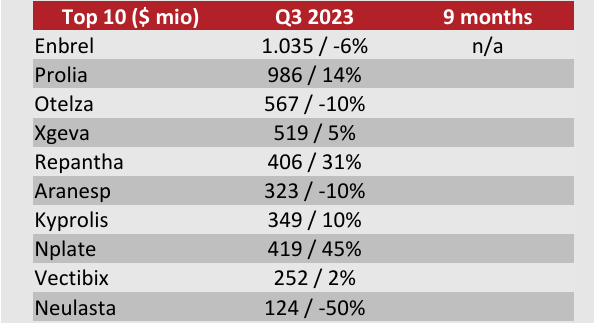
Key product results were mixed, with Enbrel, Prolia, and Nplate falling within market estimates but Otezla dropping 10% y/y, missing consensus. Amjevita, the first biosimilar for Humira, had strong growth, driven by volume, but missed expectations, as pricing pressure was evident from the introduction of numerous competitors. Enbrel continues to face pressures, declining 6% y/y but in line with expectations. The company expects continued pressure on pricing, given the number of new launches in the therapeutic area, as well as the availability of biosimilar Humira. Otezla also continues to moderate, driven by a lower sales price. Research was stopped for AMG340, a prostate cancer drug that was acquired in 2021 for $900mn, resulting in an impairment of ~$600mn.
UBS:
Not surprisingly AMGN's obesity program ('133 Ph.2 top line late '24, '786 Ph.1 data 1H24) and Tepezza's commercial trajectory were focal points. On the obesity programs, AMGN's comments around 1) no anticipated public disclosure of the '133 interim prior to data in late '24, and 2) AMGN's perceived lack of conviction in '786, stating "..as I said, it has a novel mechanism of action, it's a Phase 1 molecule. While the print was unexciting it was not unexpected. The stock closed down 2.9%, primarily due to the aforementioned obesity comments, which we view as an overreaction and a function of general investor fragility and mis-set expectations (not by AMGN). Despite an expanding set of pipeline assets that warrant attention (tarla, AMG-133, olpasiran) we do not see sufficient catalyst-driven upside at present to buy.
Novo Nordisk

Company’s view
Lars Fruergaard Jørgensen, president and CEO:
"We are very satisfied with the sales growth in the first nine months of 2023, which is reflecting that more people than ever are benefiting from our innovative diabetes and obesity treatments. Within R&D, we are pleased with the decision to stop the FLOW kidney outcomes trial early as semaglutide demonstrated a benefit in people with type 2 diabetes and chronic kidney disease. The acquisition of ocedurenone for the treatment of cardiovascular disease supports our aspiration of establishing a presence in other serious chronic diseases with high unmet medical needs."
Outlook: Raised
The outlook for sales and operating profit growth was raised on 13 October 2023 to 32-38% and 40-46% at CER.
Sales growth is now expected to be 32% to 38% at CER. Given the current exchange rates versus the Danish krone, sales growth reported in DKK is now expected to be around 4 percentage points lower than at CER. The increased sales outlook is primarily reflecting higher full-year expectations for Ozempic and Wegovy in the US.
Product sales / Clinical / Regulatory

Clinical Development / Regulatory
- Regulatory submission of once-weekly insulin icodec in the EU, the US and China
- Successful completion of phase 3 trial with higher doses of oral semaglutide
- Successful completion of phase 3 trial with 50 mg of oral semaglutide
- Successful completion of the SELECT cardiovascular outcomes trial
- Successful completion of the STEP HFpEF phase 3 trial
- Somapacitan approved in the US, EU and Japan for the treatment of growth hormone deficiency in children
- Phase 1 trials initiated with cell therapy treatment in heart failure and Parkinson's disease
Analyst’s view
Jefferies:
3Q Known, so Focus on Lower US Wegovy Discounts Driving Beat; No Supply Update.
Focus is on lower gross-to-net discounts for US GLP-1s, notably Wegovy which drives most of the beat. Given wide 2023 targets with only 4Q to go, we wonder if management now also has greater visibility on more US GLP-1 supply by YE, with implied 4Q Sales +30%-52% & EBIT +50%-75% CER vs cons c.+31% & +42% at bottom-end. No update on GLP-1 supply which will be a focus for the call. Shares likely small down.
UBS:
Company reported 3Q'23 sales of DKK23,912m for Ozempic c.1% below cons, DKK1,910m for Tresiba c.3% below cons, DKK4,496m for Rybelsus c.1% below cons, DKK2,227m for Victoza c.13% above cons, DKK54,829m for Diabetes care and obesity c.2% above cons, DKK3,902m for Rare disease sales c.9% below cons. Rare disease sales have been impacted by a temporary reduction in manufacturing output. Obesity care beat by 16% with sales of DKK12,255m, with Wegovy sales of DKK9,648m c.25% above cons and Saxenda sales of DKK2,607m c.7% below cons. Sales growth was positively impacted by gross-to-net sales adjustments, mainly for Ozempic and Wegovy in the US, partially offset by wholesaler destocking. Novo has made regulatory submissions based on the SELECT data to the FDA and EMA. There was no update on when the supply of lower doses of Wegovy would normalise.
Moderna

Company’s view
"Though this quarter, we demonstrated our ability to increase share in the U.S. market, and we now expect this year's vaccination rate to be similar to last fall," said Stéphane Bancel, Chief Executive Officer of Moderna. "In the third quarter, we significantly resized our manufacturing infrastructure to make COVID-19 franchise profitable for 2024 and beyond. We are preparing to launch multiple products through 2025, including our RSV vaccine. We expect to return to sales growth in 2025 and, through disciplined investment, to break even in 2026."
Outlook: Lowered
Moderna said its COVID vaccine has won 45% of the US market share so far this fall, up from 36% in 2022. Despite a later launch, the fall vaccinations administered in US retail pharmacies to date are tracking similarly to the 2022 fall season, Moderna said. It believes that the US market this fall will be at least 50 million doses, supporting total Spikevax sales this year of at least $6 billion. The company had previously predicted sales of between $6 billion and $8 billion this year.
Clinical Development / Regulatory
- Moderna's mRNA platform is positioned to continue to deliver significant impact with its mRNA medicines. The Company is anticipating up to 15 launches in the next five years and provided a comprehensive overview of its pipeline and clinical programs at R&D Day in September. Moderna currently has therapeutics in development across four therapeutic areas, with a total of 43 development programs.
- Moderna has advanced three respiratory disease programs to positive Phase 3 data (COVID-19, RSV, Influenza).
- R&D spending is expected to rise to $4.8 billion for the full year 2023, from $4.5 billion previously predicted.
Analyst’s view
Needham:
MRNA reported $1.8B in 3Q23 sales, just below our $1.9B and above Street $1.4B estimates. MRNA tempered 2023 sales guide to ~$6+B (was $6-8B) and provided an initial 2024 sales guide of $4B, which is well below our $5.0B and Street $6.1B estimates and suggests a much more dramatic slowdown in demand for its COVID vaccine than most investors had expected. In our view, given the long-term potential of the platform, the stock starts to become more intriguing at its current depressed levels. That said, we think COVID-related headwinds will continue to drag on shares for the foreseeable future. Maintain Hold.
Jefferies:
MRNA reported a beat and revised 2023 to low-end of prior range, and mostly in-line w/ consensus and our ests. We expected the high end was too lofty and implied Q4 after today's beat looks reasonable. Bigger disclosure is 2024-25 guidance of $4B in 2024 and growth in 2025 incl RSV. They are realistic and acknowledge buyside concerns - and our ests, and even guided cash of $13B falls to $9B in 2024 then to $6-7B in 2025 (ie $15-20/sh).
Deutsche Bank:
Analysts downgraded Moderna's stock, citing concerns about the lower sales outlook for next year and the company's plan to increase R&D spending. "The empire building leaves increasingly little room for error," they said.
Merck KGaA

Company’s view
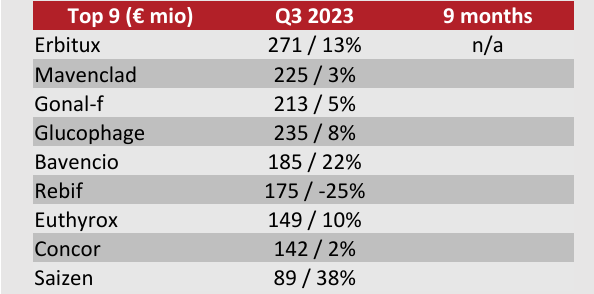
Merck confirmed its forecast for fiscal 2023 despite a difficult market environment in the third quarter. The strong organic development of the Healthcare business sector partly compensated for the decline in sales and earnings in Life Science and Electronics. Once again, Merck benefited from its diversified set-up.
Belén Garijo, Chair of the Executive Board and CEO of Merck: “We remain disciplined and on track to achieve not only our fiscal 2023 but also our medium-term targets. In 2024, we expect to return to organic sales growth.”
Outlook: Confirmed
Merck reconfirms its forecast for fiscal 2023 and specifies the indicated target corridor prior to the last quarter of the year. The company expects:
- Organic sales: -2% to +2% to a total of € 20.5 billion to € 21.9 billion – trending slightly below the mid-point of the absolute range
- Organic sales growth excluding the Covid-19 business: +1% to +5%
- Organic decline of EBITDA pre by -9% to -3% to a total of € 5.8 billion to € 6.4 billion – trending in the lower half of the absolute range
- Negative foreign exchange effects on sales and EBITDA pre: -6% to -3%
- EPS pre: € 8.25 to € 9.35 – trending in the lower half of the range.
Product sales / Clinical / Regulatory
Clinical Development / Regulatory
- Enpatoran (Oral TLR7/8 inhibitor): Phase II CLE/SLE program – futility analysis
- Evobrutinib (BTK inhibitor): Phase III relapsing MS program – read-out
- Xevinapant (IAP inhibitor): Phase III study, cisplatin-eligible LA SCCHN – Interim Analysis
Analyst’s view
Jefferies:
3Q EBITDA Beat Driven By Healthcare; Guide Maintained; LS Recovery On-Track
3Q sales broadly in-line for 4% EBITDA beat vs cons, driven by Healthcare. 2023 Group sales/EBITDApre guide all maintained with qualitative guide in-line with cons, albeit towards 'lower end', as expected. Key to note is 3Q is actually the trough for PS, with improving book-to-bill noted all pointing to an incremental recovery of the order situation for pick-up in mid-4Q23. SAP impact to SLS expected to resolve YE23. Healthcare catalyst Evo this Q still intact.
Morgan Stanley:
Solid Q3'23 EBITDA beat, FY23 guide suggests an end to the downgrade cycle
3Q'23 revenues were in line with consensus, while EBITDA and EPS beat by 4%/7% - driven by stronger profitability in Healthcare and lower corporate costs
FY23 guidance reiterated - directional guidance suggests limited changes to consensus FY23 numbers, which suggests an end to the downgrade cycle
Recovery in orders in Process Solutions still anticipated from mid-4Q'23 (as suggested at the CMD last month), book to bill slightly improved
Related Insights & Outlooks



.avif)